Alternator Voltage Regulator Guide: Failure Symptoms & Replacement
Learn how an alternator voltage regulator works, common failure symptoms, replacement options, and OE matching tips. Explore Valeo alternator regulators for wholesale automotive parts solutions.
TROUBLESHOOTING
Claire
7/17/20264 min read
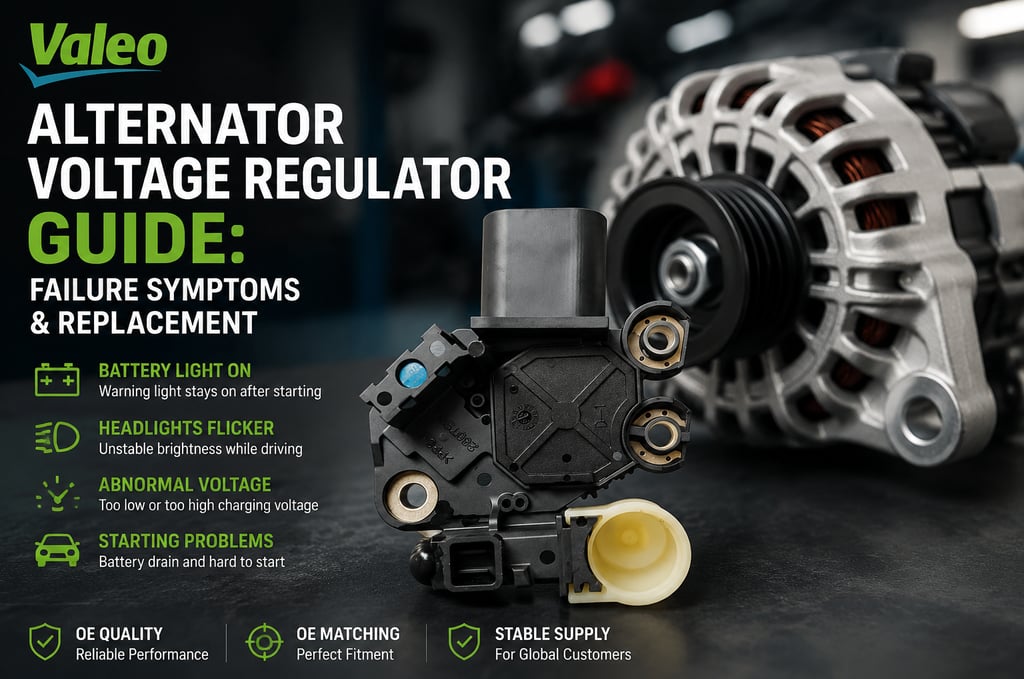
Do You Need to Replace the Regulator or the Complete Alternator?
When a vehicle shows charging problems, many people immediately assume the alternator has failed and replace the complete alternator assembly.
However, in many cases, the actual problem may come from a smaller but critical component — the alternator voltage regulator.
A faulty voltage regulator can cause battery warning lights, unstable lighting, charging failures, and even damage to sensitive electronic components.
For automotive parts distributors, repair shops, and aftermarket suppliers, understanding the role of alternator regulators helps ensure accurate diagnosis, correct part selection, and reduced replacement risks.
What Is an Alternator Voltage Regulator?
The alternator voltage regulator is an important component inside the vehicle charging system. Its main function is to control the alternator’s output voltage and keep it within a stable range.
For most 12V automotive systems, the normal charging voltage is approximately 13.8V–14.8V.
Because engine speed constantly changes during driving, alternator output voltage can fluctuate. The voltage regulator adjusts the alternator’s field current to maintain stable electrical output.
Without proper voltage regulation:
Overcharging may damage the ECU, sensors, lights, and other electronic components.
Undercharging may prevent the battery from charging properly and cause starting problems.
For professional replacement requirements, choosing a reliable alternator voltage regulator with correct OE matching is essential.
Common Symptoms of Alternator Voltage Regulator Failure
A failed alternator regulator can create symptoms that are often confused with battery problems.
1. Battery Warning Light Stays On
If the battery indicator remains illuminated after the engine starts, it may indicate a charging system failure.
Although the battery may still be new, the actual cause could be a faulty alternator voltage regulator.
2. Headlights Flicker or Become Unstable
When the voltage regulator cannot maintain stable output voltage, vehicle lighting may become brighter or dimmer depending on engine speed.
This is one of the common signs of unstable alternator performance.
3. Battery Drain and Starting Problems
A vehicle may repeatedly lose power even after replacing the battery.
If the alternator regulator is not working correctly, the battery may not receive sufficient charging current during driving.
4. Abnormal Charging Voltage
A simple voltage test can help identify charging problems.
Typical symptoms include:
Below 13V: The alternator may not be charging efficiently.
Above 15V: The system may be overcharging and could damage electrical components.
If abnormal voltage is detected, the alternator system should be inspected before replacing parts.
Why Do Some Repair Shops Replace the Entire Alternator?
Many customers ask:
“Can I replace only the alternator regulator instead of the complete alternator?”
The answer depends on the actual condition of the alternator.
There are several reasons why some repair shops recommend replacing the complete alternator assembly.
1. Complete Alternator Replacement Is Faster
Replacing only the regulator requires removing and opening the alternator.
Technicians need to inspect internal components, replace the regulator, check carbon brushes, and test the charging performance.
For some workshops, replacing the complete alternator is a faster and more convenient solution.
2. Alternator Regulators Require Accurate Matching
Modern vehicles often use integrated electronic regulators designed for specific alternator models.
A correct replacement requires checking:
OE number
Alternator part number
Vehicle application
Connector type
Voltage specification
Using an incorrect regulator may cause:
Unstable charging voltage
Battery damage
Repeated repairs
Therefore, professional buyers should always confirm the correct OE reference before purchasing an alternator regulator.
3. Other Alternator Components May Also Be Worn
An alternator regulator usually includes carbon brushes, which wear over time.
However, high-mileage alternators may also have problems such as:
Worn slip rings
Bearing damage
Rotor wear
Internal winding failure
In these situations, replacing only the regulator may not provide a long-term solution.
Alternator Voltage Regulator Replacement vs Complete Alternator Replacement
Choosing between regulator replacement and complete alternator replacement depends on the condition of the unit.
When Replacing Only the Regulator Is Recommended
Replacing the alternator regulator can be a good choice when:
✔ The fault has been confirmed to be caused by the regulator
✔ The alternator has relatively low mileage
✔ Bearings and internal components are still in good condition
✔ A reliable replacement regulator is available
For newer alternators, replacing only the damaged regulator can provide a cost-effective repair solution.
When Replacing the Complete Alternator Is Better
A complete alternator replacement may be recommended when:
✔ The vehicle has high mileage
✔ The alternator produces abnormal noise
✔ Internal components are seriously worn
✔ The correct regulator is difficult to source
Replacing the complete assembly can reduce repeated labor costs and improve long-term reliability.
How to Choose the Correct Alternator Voltage Regulator?
For automotive parts wholesalers and repair professionals, choosing the correct regulator is more important than simply finding a low-price replacement.
Before ordering an alternator voltage regulator, always confirm:
OE Number Matching
The OE number is one of the most important references for identifying the correct regulator.
The same vehicle model may use different alternators depending on:
Engine type
Production year
Vehicle configuration
Alternator Compatibility
Always check:
Alternator manufacturer
Alternator model number
Connector design
Voltage specification
A regulator that looks similar may not work correctly if the electrical specifications are different.
Brand Quality and Supply Reliability
Low-quality regulators may lead to unstable charging performance and repeated customer complaints.
For distributors and wholesalers, reliable product quality and stable supply are essential for reducing after-sales issues.
Why Choose Valeo Alternator Voltage Regulators?
As a professional automotive parts supplier, FHAS provides Valeo alternator voltage regulators and other automotive electrical components for global aftermarket customers.
Valeo is widely recognized in automotive electrical systems, and its regulators are designed according to specific alternator applications to ensure reliable charging performance.
Our alternator regulator products support:
Automotive parts importers
Wholesale distributors
Repair workshops
Aftermarket suppliers
Each product is matched with OE references to help customers identify the correct replacement solution.
👉 Explore our Valeo Alternator Voltage Regulator products for professional replacement needs.
Frequently Asked Questions About Alternator Regulators
Can a faulty alternator regulator damage the battery?
Yes. A failed regulator may cause overcharging or undercharging, which can reduce battery performance and shorten battery life.
Should I replace the alternator regulator or the complete alternator?
It depends on the alternator condition. If only the regulator has failed and other components are still in good condition, replacing the regulator may be sufficient.
For older alternators with significant wear, replacing the complete alternator may be a better solution.
How do I find the correct alternator regulator?
Always check:
OE number
Alternator part number
Vehicle application
Connector type
Correct matching helps avoid installation problems and charging failures.
Do you supply Valeo alternator regulators for wholesale customers?
Yes. FHAS supplies Valeo alternator regulators and automotive electrical parts for importers, distributors, and professional repair businesses worldwide.
Conclusion
An alternator voltage regulator failure does not always mean the entire alternator needs to be replaced.
The correct solution depends on:
Failure diagnosis
Alternator condition
Vehicle mileage
Part availability
For newer alternators with confirmed regulator failure, replacing the regulator can be an efficient and economical solution.
For older or heavily worn alternators, replacing the complete alternator assembly may provide better long-term reliability.
Understanding alternator regulator function and OE matching helps automotive professionals choose the right replacement parts and provide better solutions for customers.
FHAS Auto Parts
A brand of Chengdu Fuzhihui Auto Parts Co., Ltd.
Contact Us
Email: fuzhihui.coco@gmail.com
Coco Huang| Business Manager
Company


Support
Legal
Global Auto Parts Supplier
Professional supplier of alternators, starters and compressors.
© 2026 FHAS Auto Parts. Chengdu Fuzhihui Auto Parts Co., Ltd. All Rights Reserved.
Whatsapp: 86-15528256866