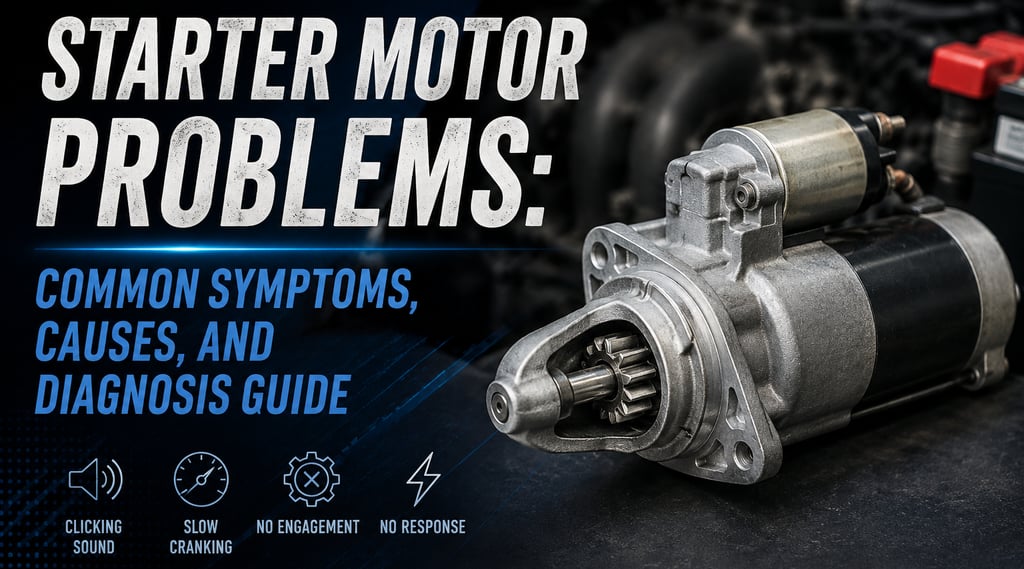
Starter Motor Problems: Symptoms & Diagnosis
Learn the most common starter motor symptoms, their causes, and simple diagnostic steps to identify starting system problems quickly.
TROUBLESHOOTING
Claire
6/12/20262 min read
Introduction
A starter motor is one of the most important components in a vehicle's starting system. When it fails, your car may crank slowly, make unusual noises, or refuse to start altogether.
This guide explains the most common starter motor symptoms, their possible causes, and a step-by-step diagnostic process to help identify the problem quickly.
Common Symptoms of a Faulty Starter Motor
1. Clicking Sound but Engine Does Not Start
If you hear a single click or repeated clicking noises when turning the key, the starter motor may not be receiving enough electrical power.
Possible causes include:
Weak or discharged battery
Corroded battery terminals
Damaged starter relay
Faulty starter solenoid
Poor ground connection
2. Slow Cranking
A slow-cranking engine is often an early warning sign of starter system problems.
Common causes:
Low battery voltage
Worn starter brushes
Dirty commutator
High resistance in wiring connections
Internal starter motor wear
3. Starter Spins but Engine Does Not Crank
In some cases, the starter motor rotates normally but fails to engage the engine.
This usually indicates:
Worn overrunning clutch (starter drive)
Damaged pinion gear
Faulty engagement mechanism
4. Grinding or Gear-Clashing Noise
A grinding noise during startup often indicates improper gear engagement.
Possible reasons:
Worn starter pinion gear
Damaged flywheel ring gear
Incorrect starter installation
Worn shift fork
Ignoring this symptom can lead to expensive flywheel damage.
5. No Response When Turning the Key
If absolutely nothing happens when attempting to start the vehicle, check:
Battery voltage
Main power cable
Ground cable
Ignition switch
Starter relay
Fuse condition
Step-by-Step Starter Motor Diagnosis
Step 1: Check Battery Condition
Measure battery voltage.
12.6V or higher = fully charged
Below 12.2V = battery may require charging
Turn on the headlights while starting. If they dim significantly, the battery could be weak.
Step 2: Inspect Electrical Connections
Check:
Battery terminals
Ground straps
Starter power cable
Solenoid signal wire
Clean corrosion and tighten loose connections.
Step 3: Test the Starter Relay
Swap the relay with an identical working relay if available.
If the vehicle starts normally afterward, replace the relay.
Step 4: Check Solenoid Signal Voltage
Using a multimeter, verify that the solenoid receives approximately 12V when the ignition key is turned to the START position.
No voltage usually indicates:
Ignition switch failure
Wiring issues
ECU control problems (on modern vehicles)
Step 5: Perform a Bench Test
Remove the starter motor and perform a controlled bench test.
Observe:
Rotation speed
Abnormal noise
Excessive vibration
Gear engagement performance
This helps distinguish electrical faults from mechanical failures.
Common Internal Starter Motor Failures
Worn Carbon Brushes
Carbon brushes gradually wear over time.
Symptoms include:
Intermittent starting
Slow cranking
Excessive heat
Damaged Bearings or Bushings
Worn bearings may cause the armature to contact the housing.
Typical signs:
Scraping noise
Excessive vibration
Reduced efficiency
Burned or Dirty Commutator
A damaged commutator reduces electrical contact quality.
Results include:
Power loss
Hard starting
Excessive sparking
Conclusion
Most starter motor problems can be traced to battery issues, wiring faults, solenoid failures, or internal wear. Following a systematic diagnosis process can save time, reduce repair costs, and prevent unnecessary parts replacement.
Regular inspection of the starting system helps ensure reliable engine starts and extends starter motor service life.
FHAS Auto Parts
A brand of Chengdu Fuzhihui Auto Parts Co., Ltd.
Contact Us
Email: fuzhihui.coco@gmail.com
Coco Huang| Business Manager
Company


Support
Legal
Global Auto Parts Supplier
Professional supplier of alternators, starters and compressors.
© 2026 FHAS Auto Parts. Chengdu Fuzhihui Auto Parts Co., Ltd. All Rights Reserved.
Whatsapp: 86-15528256866